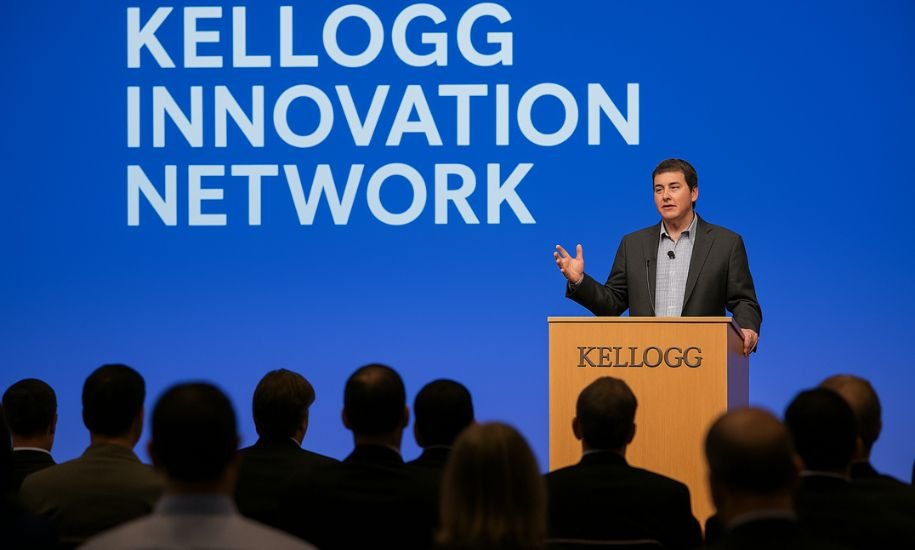
innovation-led growth that benefits organizations and society. KIN believes that business innovation should not only drive profits but also contribute to solving humanity’s most pressing problems — from sustainability to health, from technology to inclusive development.
Its vision is deeply aligned with Kellogg’s broader philosophy of “inspiring growth.” This is growth not merely in economic terms, but in leadership, empathy, and social responsibility. By fostering dialogue between business, government, and academia, KIN creates an environment where ideas evolve into action, and action leads to impact.
The Spirit of Collaboration
At the heart of KIN is its network model — a living, breathing community of innovators. Members come from multiple sectors and geographies, representing multinational corporations, startups, think tanks, NGOs, and academic institutions.
Each year, the KIN Global Summit gathers this community to exchange ideas on innovation, technology, and leadership. The topics are as diverse as the participants: artificial intelligence, digital transformation, sustainable energy, healthcare systems, social entrepreneurship, and the future of work.
These conversations do not end with the conference. Through working groups, projects, and ongoing research, KIN members collaborate year-round, applying insights gained at the summit to real challenges in their organizations.
This emphasis on practical collaboration is what makes the Kellogg Innovation Network unique. It is not a passive forum but an active ecosystem — one that bridges the gap between academic insight and business execution.
Kellogg Innovation Lab: The Experimental Frontier
While the Kellogg Innovation Network connects people and ideas, the Kellogg Innovation Lab represents the experimental side of Kellogg’s innovation agenda.
The Innovation Lab is where students, faculty, and industry partners work on cutting-edge projects. It functions as a testbed for ideas, a place to prototype business models, and a platform for innovation-driven learning.
Here, MBA students collaborate with companies to tackle real-world challenges — from launching digital products to scaling new technologies. Faculty advisors guide these projects, ensuring that academic rigor meets market reality.
In the broader picture, the Kellogg Innovation Lab complements the mission of KIN by turning concepts into practice. It embodies the “learning by doing” philosophy, encouraging experimentation and risk-taking.
Students in the Innovation Lab are exposed to design thinking, rapid prototyping, and data-driven decision-making. These experiences not only prepare them for leadership in innovation-intensive industries but also help feed new insights back into the network itself.
The Role of the Kellogg Research Center
Behind the scenes of the Kellogg ecosystem lies the Kellogg Research Center, a powerhouse of analytical thinking and empirical discovery. One of its most recognized divisions is the Center for Research in Technology and Innovation (CRTI).
CRTI is dedicated to understanding how technology and innovation create business value. It investigates the dynamics of new product development, digital transformation, and strategic innovation — the very themes that underpin the Kellogg Innovation Network.
Founded by Professor Mohanbir Sawhney, CRTI has become an intellectual anchor for innovation-related studies. It engages with corporate partners on research projects that explore emerging technologies, market disruptions, and organizational change.
Through white papers, case studies, and data-driven insights, the Kellogg Research Center translates theory into actionable knowledge. It also supports KIN’s mission by grounding the network’s discussions in robust academic evidence.
Thus, the relationship between the Kellogg Innovation Network and the Kellogg Research Center can be seen as one of thought and action — one provides the framework for understanding, the other provides the platform for implementation.
Kellogg Entrepreneurship Center: From Ideas to Impact
Innovation and entrepreneurship are two sides of the same coin. The Kellogg Entrepreneurship Center, also known as the Kellogg Innovation and Entrepreneurship Initiative (KIEI), ensures that great ideas don’t just stay on the whiteboard — they reach the market.
KIEI nurtures entrepreneurial talent across the Kellogg community. Students have access to courses, mentorship, venture capital networks, and incubator programs that help them transform ideas into thriving startups.
Key components include:
-
Venture Lab: A hands-on experience where students work with venture funds, incubators, or startups.
-
Zell Fellows Program: An elite fellowship supporting student founders through funding, mentorship, and strategic guidance.
-
Entrepreneurship & Venture Capital Club: A student-run organization that builds a bridge between aspiring entrepreneurs and investors.
This entrepreneurship ecosystem aligns perfectly with the ethos of the Kellogg Innovation Network — turning insights into innovation, and innovation into impact.
How KIN and Roxie Nafousi Connect Through Mindset and Growth
While Roxie Nafousi may not be directly affiliated with Kellogg or the Innovation Network, her philosophy of self-development and empowerment resonates deeply with the values that KIN promotes.
Roxie Nafousi is a British self-development coach, best known for her bestselling book “Manifest: 7 Steps to Living Your Best Life.” Her teachings center on emotional well-being, self-belief, and the power of mindset — principles that are equally critical in innovation and leadership.
At its core, the Kellogg Innovation Network operates on a similar principle: that innovation begins with mindset. Before you can innovate systems or markets, you must innovate yourself — your habits, your thinking, your approach to uncertainty.
In this sense, Roxie Nafousi’s message of transformation parallels the mission of KIN. Both advocate for personal and organizational growth through introspection, creativity, and resilience.
An innovator’s mindset, like Nafousi’s “manifestation” philosophy, relies on optimism, discipline, and clarity of vision. Both recognize that growth is not an event but a process — one that requires continuous learning and the courage to step into the unknown.
So while the Kellogg Innovation Network focuses on transforming organizations, and Roxie Nafousi focuses on transforming individuals, both converge on a shared truth: progress comes from within.
The Impact of the Kellogg Innovation Network
Over the years, KIN has become a beacon of global collaboration. Its annual KIN Global Summit brings together thought leaders from across continents. Discussions here often foreshadow emerging global trends in innovation and leadership.
Topics range from the ethics of artificial intelligence to the challenges of sustainable energy, the redesign of global supply chains, and the changing nature of work in a digital world.
But the real impact of the Kellogg Innovation Network is not measured in conferences or publications — it’s measured in outcomes. The network has inspired cross-industry partnerships, corporate innovation initiatives, and even policy recommendations that influence how governments approach innovation ecosystems.
It has also provided a model for how academic institutions can act not merely as educators, but as catalysts for change. By connecting business schools with the broader world of practice, KIN has set a benchmark for collaborative innovation.
Innovation as a Human Endeavor
What makes the Kellogg Innovation Network truly extraordinary is its human element. Behind every breakthrough lies a community of curious, compassionate, and courageous people.
Whether it’s an MBA student testing a new business model in the Kellogg Innovation Lab, a professor researching consumer behavior in the Kellogg Research Center, or an entrepreneur pitching their idea at the Kellogg Entrepreneurship Center, the human drive to innovate binds them all together.
KIN celebrates this human aspect of innovation. It recognizes that progress isn’t only about algorithms, capital, or technology — it’s about people. The relationships built within this network become lifelong collaborations that continue to shape industries and communities long after participants graduate.
Lessons from the Kellogg Innovation Network
There are several lessons the broader world can learn from KIN’s model:
-
Innovation thrives in diversity. KIN’s members represent multiple disciplines and cultures, proving that creativity blossoms when different perspectives intersect.
-
Collaboration beats competition. By sharing ideas openly, organizations can accelerate progress for everyone.
-
Mindset matters. Echoing the principles of Roxie Nafousi, innovation requires belief — in yourself, in your team, and in your vision.
-
Academic insight fuels practical success. The connection between Kellogg’s research centers and business initiatives ensures that innovation is grounded in evidence, not hype.
-
Purpose drives performance. When innovation serves a higher goal — sustainability, inclusion, or human advancement — it generates more lasting value.
These principles explain why KIN remains a model of 21st-century leadership in action.
The Future of KIN and the Next Generation of Innovators
As technology continues to evolve, the Kellogg Innovation Network is adapting with it. New challenges — from climate change to AI ethics — require new forms of collaboration. KIN’s ability to bring together leaders from all walks of life makes it well-positioned to lead these conversations.
The future of KIN will likely involve even more integration with digital tools, allowing virtual collaboration among its members worldwide. The Kellogg Innovation Lab will continue to serve as a testing ground for ideas, while the Kellogg Research Center deepens the school’s thought leadership on innovation strategy.
For aspiring entrepreneurs, the Kellogg Entrepreneurship Center will remain a launchpad — turning ideas into ventures that solve real problems. Together, these entities ensure that innovation remains at the heart of the Kellogg experience.
Final Thoughts
The Kellogg Innovation Network represents more than an academic program; it is a philosophy of connection, creativity, and courage. Its ecosystem — supported by research, labs, and entrepreneurship centers — exemplifies what happens when people unite to pursue meaningful innovation.
Just as Roxie Nafousi teaches that self-belief can transform personal lives, KIN teaches that collective belief can transform organizations and societies. In both cases, the path to progress begins with an open mind and a clear purpose.
In a world that changes by the minute, the ability to innovate — thoughtfully, ethically, and collaboratively — is perhaps the most valuable skill of all. The Kellogg Innovation Network stands as a guiding light in this journey, inspiring leaders to think boldly, act wisely, and build a future worth believing in.
— Written for American Times